
マグ

川風が動く。
舟が出る。
江戸の夏は、
水の上へ逃げていく。
『船徳』は魚そのものの噺ではない。しかし、舟、川、江戸湾の気配を通して、夏の江戸前を読むことができる。穴子はその水辺の記憶に寄り添う魚である。
助六:
『先生、穴子って魚ですかね。』
純基先生:
『魚だな。』
助六:
『じゃあ江戸前ですか。』
純基先生:
『舟が出て、川風が吹いて、江戸湾の時間が動く。そこまで揃って江戸前だ。』
助六:
『魚だけじゃないんですね。』
純基先生:
『穴子は、水辺の江戸前を思い出させる。』
図版候補:江戸名所・隅田川・舟遊び関連資料
First comes sardine.
Not because it is expensive.
Not because it is rare.
But because Edomae has always been a culture of timing.
If not now, then when?
鯖の魚屋噺
足の早い魚が来る。
急げ。
秋の市場は、
待ってくれない。
鯖は鮮度の魚である。落語の魚屋噺において、鯖は急ぎ、声、値段、商売の間合いを引き出す。
助六:
『先生、鯖って魚ですかね。』
純基先生:
『魚だな。』
助六:
『じゃあ江戸前ですか。』
純基先生:
『早く売って、早く食べて、早く次へ行く。そこまで揃って江戸前だ。』
助六:
『魚だけじゃないんですね。』
純基先生:
『鯖は、市場の急ぎ足だ。』
図版候補:魚売り・棒手振り・江戸の商売風景
First comes sardine.
Not because it is expensive.
Not because it is rare.
But because Edomae has always been a culture of timing.
If not now, then when?
Eel —Gogai
The heat grows deeper.
The calls of the eel vendors grow louder.
In Edo,
people survived summer
by eating the season.
Eel is deep.
It’s a fish.
First comes sardine.
Not because it is expensive.
Not because it is rare.
But because Edomae has always been a culture of timing.
If not now, then when?
Edomae. —Gogai
An evening in Akasaka.
The Beatles fill the room.
I Want To Hold Your Hand.
I Saw Her Standing There.
Somehow,
it feels like we’ve heard this story before.
First comes sardine.
Not because it is expensive.
Not because it is rare.
But because Edomae has always been a culture of timing.
If not now, then when?
VOICE DRIFTS
Fragments from the archive.
Selected acts performed
in narration and spoken dialogue.
Act I — Edomae, Of Course.
First comes sardine.
Not because it is expensive.
Not because it is rare.
But because Edomae has always been a culture of timing.
If not now, then when?
First comes sardine.
Not because it is expensive.
Not because it is rare.
But because Edomae has always been a culture of timing.
If not now, then when?


Act IV — Across the Pacific
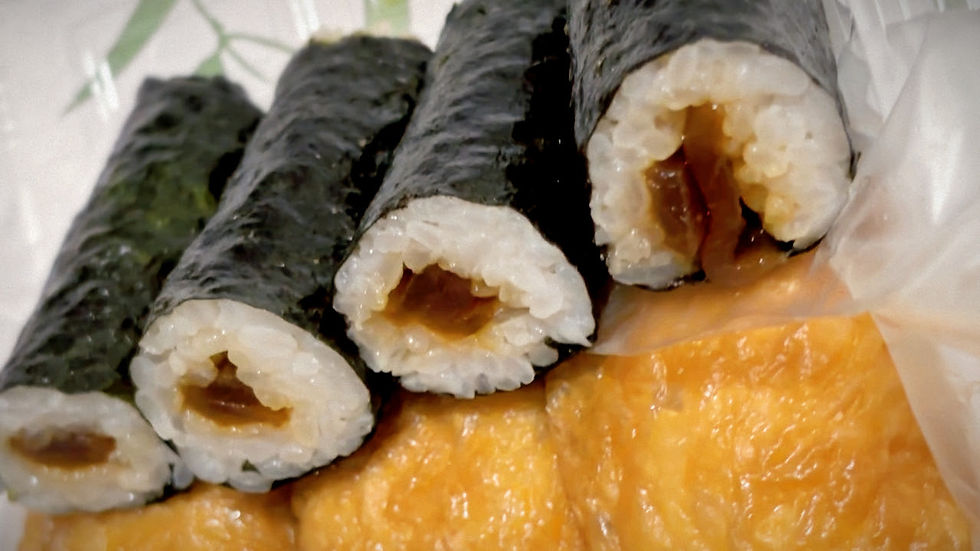
One roll crosses an ocean.
Then another.
Before long, Japanese food is traveling farther than anyone imagined.
The Pacific becomes part of the menu.
One roll crosses an ocean.
Then another.
Before long, Japanese food is traveling farther than anyone imagined.
The Pacific becomes part of the menu.


Act VII — The Supporting Cast

The star may be fish.
But no performance survives without the supporting cast.
Rice.
Seaweed.
Shiso.
Craftsmen.
Markets.
The story depends on all of them.
The star may be fish.
But no performance survives without the supporting cast.
Rice.
Seaweed.
Shiso.
Craftsmen.
Markets.
The story depends on all of them.


The Beauty of Shiso
Act VI — The Beauty of Shiso
Fast-paced rakugo dialogue.
Fish and rice have not changed much over the years.
Yet the landscape of Japanese cuisine has continued to evolve.
This act begins with a single shiso leaf and explores the way Japanese food is seen.
One leaf can change the impression of a plate,
reshape a composition,
and alter the outline of a culture.
Before taste, there is color.
Before color, there is landscape.
A story that follows the sense of season carried by the ingredients themselves.
Lyrics
Welcome to the neighborhood—
Nihonbashi, Horidome-cho.
Next thing you know—
Little Tokyo, Los Angeles.
Now look at us—
Tokyo
Kaikan—
well…
something like it.
Legendary, they say.
Depends where you’re standing.
There they go again—
the Eiwa guys, talking.
Come to think of it—
I was going on about oba earlier—
with Junki-sensei.
Master goes—
Back then—
oba…
wasn’t there.
Not absent—
just not yet.
Funny thing is—
the fish hasn’t changed.
Nor the rice.
So I ask—
what did that change?
Junki-sensei—
you were thinking the same thing,
weren’t you?
Master just goes—
how it’s seen.
Then Photographer—
he says—
it’s about color.
White.
Red.
But something’s missing.
And I go—
Green.
That’s it.
Green.
Now—
back then,
oba wasn’t in circulation.
Didn’t exist?
No—
just hadn’t arrived yet.
You see—
it was brought in.
By hand.
That’s how it starts.
Then—
it settles.
Takes root.
Tuner—
she says—
IMP,
back then—
was working with Nagatoshi Farm
out in San Diego.
So I say—
it didn’t just arrive—
it settled in, huh.
only on the West Coast.
That’s where it sticks.
One leaf—
changes the whole thing.
Gives it an edge.
Creates contrast.
Was it added?
No—
it passed through.
Just one leaf!
That’s all it takes.
Before taste—
there’s color.
Before color—
there’s a landscape.
Landscape?
what, you mean a sashimi platter?
Master—
puts it simply—
There are hands.
And that’s where it lands.
Still—
no room to fake it.
Not even a leaf!
…right, Junki-sensei?
fair enough!
“Damn, that pops and floats!”
Now this Ishidai...Wow...exceptional.
Heh—now that’s the stuff!
The Supporting Cast
Act VII — The Supporting Cast
Spoken rhythm narration.
Fish may be the star.
Everyone knows that.
But the people of the market also understand the importance of everything around it.
Daikon.
Cucumber.
Wasabi.
Yuzu.
Shiitake.
Shishito.
This act celebrates the colors that bring Japanese cuisine to life.
Japanese food is not merely a collection of ingredients.
It is a culture of relationships.
Fish and greens travel together,
pass through the same seasons,
and meet again on the same plate.
Layer by layer,
they create a landscape of their own.
Lyrics
Sukeroku
Welcome—Tsukiji, Toyomi-cho—
Next stop—L.A., Little Tokyo—
Now look—Tokyo Kaikan—
Same place—depends how you see it—
Legendary? Yeah—
they say it—
—
There they go—
Eiwa flow—
Not talking—
that’s a rap show—
—
Weaver (fast)
Shiso—nori—snap, no delay—
Cucumber cool—cut through the day—
Wasabi sharp—right where it lands—
Sudachi lift—back in your hands—
—
All
Around it—
around it—
around it—
—
Sukeroku
Full cast—
no lead—
just balance—
—
Junki-sensei (calm)
It’s not the fish alone—
it’s everything around it
that brings it together.
—
Sukeroku (cuts in)
Yeah, yeah—
around it, around it—
but that’s just sides.
—
Junki-sensei
Not sides—
structure.
—
Sukeroku
Structure?
You mean garnish.
—
Junki-sensei
No—
placement.
Where it lands—
that’s the difference.
—
Sukeroku (laughs)
Yeah?
Then why’s wasabi
doing all the work?
—
Junki-sensei (slight smile)
Exactly.
—
Sukeroku (grins)
…Alright.
So it’s not the fish—
—
Junki-sensei
It never was.
—
(beat)
—
Sukeroku
Still—
you mess it up—
you’ve got nothing.
—
Junki-sensei
That’s the point.
—
Cherry blossoms—
gone fast—
Air getting thick—
you feel that?
—
Junki-sensei
Yeah…
—
Sukeroku
2025—
that heat came fast—
No shade—
no break—
just blast—
—
Weaver (soft, rhythmic)
Yuzu—
Wasabi—
Two lines—
same body—
—
Sukeroku
One cool—
one sting—
Same plate—
same thing—
—
Still—
that’s what holds—
—
Mechanist
Structure.
—
Tuner
Same truck—
same route—
Fish and greens—
all in one move—
—
Sukeroku
There you go—
now we groove—
One stop—
that changed the truth—
—
Daikon first—
cut clean—
Aokubi—
green top—
white sheen—
—
Junki-sensei
Green neck.
—
Sukeroku
Green?
That’s a joke—
—
Grader
Just the top.
—
Sukeroku
Still counts—
no revoke—
—
Weaver (flow)
Cucumber—
eggplant—
kaiware—
Shiitake—
shishito—
all there—
—
Season shifts—
fruit in the mix—
—
Junki-sensei
Not just fish—
—
Master
It stands—
with what it sits with—
—
Sukeroku
Blossoms gone—
Same heat back—
—
Tuner
Not yet—
rain check that—
—
(beat)
—
Sukeroku (low)
Yuzu—local—
Made it work—
That heat?
we cut—
no burn—
Yuzukiri—
—
(beat)
—
Sukeroku (picks up, fast)
“U,” right—
Unagi—
Uri—
Umeboshi—
Udon—
—
Heat’s coming—
—
Junki-sensei (cuts in)
Hold on—
not yet.
—
(beat)
—
We’ve got rain first.
—
Sukeroku (grins)
Ah—
soaked…
then sun.
—
(beat)
—
Master (quiet, final)
That’s when—
the sardines come in.
—
Nyubai iwashi.
Bridging Time and Place
Act IX — Bridging Time and Place
Slow acoustic storytelling.
Who was Sharaku?
No one truly knows.
Yet even when the people he drew have disappeared,
their outlines remain.
This act follows the ways of seeing and deciding that have been passed down beyond names,
from Edo printmakers to the people of the market.
Edomae is much the same.
No scene ever appears twice.
And yet,
somehow,
it feels familiar.
Time and place may be far apart,
but everything settles into place.
A story that finds delight in the small shifts of time.
Lyrics
Weaver
Not cut—
left.
the edge—
decides.
Time’s off—
still it fits.
Sharaku—
who’s that?
who’s behind
the frame?
No one knows.
Time’s off—
still it fits.
And yet—
he’s drawing
now.
This frame—
doesn’t it
feel familiar?
…like that time?
Time’s off—
still it fits.
pattern holds.
repeat comes.
Not form—
outline.
Not clear—
but it stays.
Time’s off—
still it fits.
No same frame.
Same way—
of deciding.
incomplete.
That’s why
it continues.
Someone
who shouldn’t be here—
still drawing.
…well—
Rolls are in.
Shibaimachi—
crowded tonight.
If the edge is set—
it won’t get lost.
---
(Coda — Hori-dome-cho)
Hori-dome backstreet—
a small soba place.
Goldfish cup—
just one more.
Play me a quiet night,
let the rim find the light—
we’re all just passing the frame along.
…doko ka de mita—
…ah—
…Sha…
…ra…
…ku—
Edomae Goes On
Act X — Edomae Goes On
A Spoken Journey at Dusk
The fish tale that began with a sujiko rice ball in Tsukiji
finally reaches its closing act.
The grader.
The storyteller.
The photographer.
The tuner.
The mechanist.
The cast gathers once more,
quietly reflecting on the roles they have played.
We thought we were moving fish,
choosing fish,
and talking about fish.
But perhaps,
without realizing it,
we were moving time itself.
A market is a place where fish are sorted.
It is also a place where culture grows.
This is not an ending.
It is a story meant to be passed on to someone else.
Edomae,
somewhere,
continues even now.
Lyrics
Sukeroku
Alright—
Act Ten.
Final cut.
⸻
Started with—
in Tsukiji.
⸻
Edo to Los Angeles—
rolling through time.
⸻
…you know the story.
⸻
But this—
this is the floor.
⸻
Where it all gets sorted.
⸻
Junki-sensei—
⸻
You see this one?
Good fish?
Or just—
good talk?
⸻
(beat)
He don’t rush.
Just looks.
Just listens.
…yeah.
That’s his answer.
⸻
Grader—
one bite.
⸻
Tell me—
is it there?
⸻
(beat)
He nods.
That’s enough.
Balance—
ain’t numbers.
It’s memory.
⸻
Weaver—
you already threading it, huh.
⸻
From box—
to plate—
to story.
⸻
You don’t say much.
But it flows.
⸻
Tuner—
⸻
Hold up—
this line’s off.
⸻
(beat)
…there.
You didn’t even look.
Still fixed it.
⸻
Invisible work.
Whole place stands on that.
⸻
Hey—
Photographer.
⸻
Don’t shoot the fillet.
⸻
Shoot the face.
⸻
Fish got a face.
Color starts there.
⸻
…yeah.
That’s the one.
⸻
Mechanist—
⸻
lemme ask you—
⸻
what’s the next roll?
⸻
Not this one.
Next.
⸻
(beat)
He says—
everything’s already there.
⸻
You just—
cut different.
⸻
Selection is exclusion.
…right.
⸻
Now me?
⸻
Still asking.
Fish first?
Rice first?
⸻
Stirring it.
Always.
⸻
And him—
Master.
⸻
He don’t step in.
⸻
Doesn’t need to.
⸻
Says—
before the fish hits the board—
the rice is already set.
⸻
…yeah.
That’s the line.
⸻
[longer pause]
…you hear that?
⸻
We thought—
we were making something.
⸻
Turns out—
this place was making us.
⸻
Sorting.
Aligning.
Cutting.
Tasting.
Seeing.
⸻
All of it—
still moving.
⸻
So—
this ain’t the end.
⸻
We just—
pass it on.
⸻
…aight.
⸻
Next round’s on you.
⸻
MASTER CUTS
Stories drifting between fish,
time,
and culture.
A ten-act narrative archive.

MASTER CUTS — A Fish Tale Set in an Imagined Tokyo Kaikan
A ten-act storytelling series originally published through the Spring 2026 EMP newsletter archive.
Told in the style of a traditional yose theater performance, the series traces the history of the EIWA Group through adventures in fish culture, seasonal memory, and the spread of Japanese seafood traditions abroad.
While grounded in real people, conversations, and market history, the story unfolds inside an imagined version of the legendary Tokyo Kaikan — a vanished setting reinterpreted here as the symbolic birthplace of the California Roll.
Through encounters with graders, craftsmen, photographers, and wandering storytellers, MASTER CUTS documents the evolving relationship between fish, handling, hospitality, and the invention of Japanese food culture overseas.
Now archived as part of EMP Tokyo’s evolving editorial chronology.
Each entry traces fragments of the Eiwa Group’s history,
through stories shaped by fish, handling, and time.
Copyright for all images and photographs belongs to their respective rights holders.
Source references and acknowledgements are noted throughout each entry.